Showing posts with label america. Show all posts

Wednesday, August 4, 2010

Referendum Day

Today's the big day! August 4, 2010 could go down as an historic day in the development of Kenyan democracy. It's constitutional referendum day, with millions of Kenyans heading to the polls to cast a simple vote - Yes or No - on a new Proposed Constitution of Kenya. Here's a run-down of information on the referendum for anyone who is interested...

1. The text of the proposed constitution can be found here, or if you want the Cliff Notes version, you can scan the Wikipedia entry for it.

2. It would be SHOCKING if 'Yes' doesn't win. The polls over the past two months have been showing steadily increasing support for the proposed constitution. I think the most recent one I saw had something like 70% in favor, 20% against, 10% undecided. Which means that if somehow 'No' is announced as the outcome, you would be a fool not to conclude corruption is at play...

3. Because corruption ain't no joke in Kenya.


4. The people who are against the constitution are, generally speaking, motivated by religion. Although the constitution clearly defines life as beginning at conception, it also has a clause that provides for abortion in certain cases. It states: "Abortion is not permitted unless, in the opinion of a trained health professional, there is need for emergency treatment, or the life or health of the mother is in danger, or if permitted by any other written law." People have been traveling the country assailing the constitution because it will permit the killing of babies. Sound like American politics? That's because it is. The 'No' campaign has been receiving thousands (if not millions) of dollars from evangelical Christians in America, and has even gotten support from a New Jersey Republican Congressman who serves on a sub-Saharan Africa committee. The Congressman (whose name I forget; I read it in the Daily Nation a few weeks ago), has held up the abortion clause in his condemnation of the Constitution, although my best guess is that he hasn't even glanced at the document. I wonder if a Republican politician would even care about the referendum if Obama's roots happened to be in another African country?

The other big religious (Christian) objective to the proposed constitution is the continued inclusion (from the original constitution) of Kadhi Muslim family courts, which would be a subordinate court under Kenya's superior courts (Supreme Court, Court of Appeal, High Court). In addition to having operated in Kenya since its independence in 1963, these Muslim family courts are found throughout the Islamic world. The proposed constitution states: "The jurisdiction of a Kadhis’ court shall be limited to the determination of questions of Muslim law relating to personal status, marriage, divorce or inheritance in proceedings in which all the parties profess the Muslim religion and submit to the jurisdiction of the Kadhi’s courts." So to be clear, the courts are only for people who profess Muslim faith, and even then, it's up to them if they choose to submit to the jurisdiction of the court. And it's only related to familial matters - marriage, divorce, inheritance, personal status. And they are subordinate to higher courts. So what's the problem here? It's no doubt true that America is a big influence in Kenya, but unfortunately that includes the bad influences as well. From what I've read, discrimination against Muslims in Kenya - a group that makes up 25% of the country's population - has risen dramatically since the 9/11 terror attacks. This is just more fear mongering by the country's wannabe American evangelicals.

Ryan Ubuntu had a good blog post a few weeks ago that provides some great insight into the religious fervor against the constitution. Pretty scary stuff.

5. Really, the only sane way to use religion in this whole referendum process is to pray that there won't be any violence. Most of the world probably remembers the horrible violence and rioting that took place after the corrupt Presidential election of December 2007. Over 1,100 people died. Kisumu, the nearest city to me, was a hotbed of violence and rioting. I'm confident that there won't be any problems this time around though. First of all, Kisumu is a hotbed of Yes. Virtually everybody's Yes in Western and Nyanza Province. For the most part, the No folks are limited to the Rift Valley. Most of the rest of the country, as the polls are indicating, are strongly Yes. So, it's simply not as contested as the 2007 election was (unless a fast one is pulled and No is announced the winner....yikes).

Secondly, the government has done a good job of taking security precautions. For instance, the government has forced the cell phone companies (Safaricom, Zain, and Orange) to require every single one of the customers to register their phone number in person with photo identification. Every single phone number in Kenya has a name attached to it now. Even mine. I had to go into the Zain store in Kisumu, wait in a long line, and then show them my passport and fill out a form as they registered my number and name in their computer. If I hadn't registered by July 30th, my phone would have been shut off. We even had to register our Safaricom internet modem as well.

As a side note, this precaution would be looked upon approvingly by author Robert Wright as a "non-zero-sum" game. Yes, it's forcing citizens to surrender some personal liberties, but the purpose is to keep them safe. This is the part of Nonzero that I struggled with most - I've been hard-line against the Patriot Act following 9/11, but Wright, even though he wrote the book before 9/11, seemed to be promoting the sacrifice of such personal liberties for the safety of the human race in a nuclear world.

6. The two sides have chosen colors. Green for Yes, Red for No. I was wondering if these colors had larger ideological significance like Blue and Red have in the U.S., but apparently this is the first time they have been used in a prominent national election to represent head-to-head interests. I have a feeling that this could be the birth of an ongoing Green-Red competition in Kenyan politics with each color having an over-generalized meaning. Again, America is not always a good influence.

7. Nonetheless, like Ben, I'm wearing a green shirt today. Stay tuned for the result.

Thursday, July 8, 2010

Food Inc.redible!


The picture to the right is what a typical dinner looks like for Patrick and me every night here. The house-help cooks breakfast, lunch, and dinner for us every day - we are seriously spoiled. The food is brought out in the containers that you see in the picture. It's a surprise every night to open up the lids and see what's inside them. We can usually count on a few things: rice or spaghetti, beef or chicken, a broth made from the meat, some form of potatoes, greens called sukuma wiki (which literally translates as "push the week," because the dish is a cheap way to fill up a week's worth of meals), and a cornbread-ish side dish called ugali, which is an East African staple for every lunch and dinner (Kenyans say it's not a meal unless you have ugali).

Put it all together, add a Coke, and you've got a delicious meal! As a side comment, a few things about our meals here:

1. Patrick and I eat alone. One-on-one, two men, talking about men stuff at the end of each long day of public service.

2. The women all eat in the kitchen, which is located in the small hut in the back of the house. I've asked them if we can all eat together, but they don't seem too "in to it." I think they like being separate from us (I can hear them laughing and having a good ol' time  back there every night). I asked them if they usually eat inside at the dining table where Patrick and I eat when they don't have visitors, and they said no. They always eat at the kitchen table. This makes sense to me, as Americans often simply eat at the kitchen table instead of the more formal dining table on an average night. It's just easier and more comfortable, right?

3. Patrick and I have good conversations nonetheless though. 

4. Toothpicks or floss are essential after each meal...I'll explain why a little later.


Tasty food is all well and good, but as someone who knows me, you may be aware that earlier this year I became an organic/local/ethical food disciple after seeing the documentary Food Inc. (which has led me to become a Whole Foods shopper under the tutelage of David Monteith, and to reject fast food from my diet - a pretty big shift from a year ago when I worked at McDonald's headquarters and ate their food everyday!). So much like Food Inc. takes you behind the scenes of the food we eat in the U.S., this blog post, "Food Inc.redible!" aims to give you a behind the scenes look at where this amazing food that winds up on my plate every night comes from. Hint: You don't have to look far.

Let's start with the staple food: corn, or as Kenyans call it, maize. Walking around the village here, it is easy to notice that corn is grown on every plot of land (as I pass by the tall, leafy green stalks, I keep on half-expecting Shoeless Joe Jackson to appear, or at least a Kenyan version of him, but it hasn't happened yet...). Kenyans plant (and harvest) their crops twice a year - in March and September. It's currently harvest time in Es'saba, hence the picture to your right. I walked out of the house one day and came upon this sight - hundreds of cobs of corn sprawled out on the ground of the compound. I was utterly confused and intrigued. I hadn't seen anyone put the corn there, so it was unexpected. I found out that this was the first step in a whole process for cultivating each maize harvest. After removing each cob from the stalk, Welliminah hired some help to spread out all the corn on the ground in order to dry all the kernels out. After a few days of this, they started removing all of the kernels from the cobs, putting them in sacks and continuing to let them dry out every afternoon under the sun. Finally, they will take the sacks of dried kernels up to the marketplace to have them ground into flour, or maize/cornmeal called unga or posho. This flour is the stuff that ugali is made from, and served at every meal (I've seen ugali being made - it's basically identical to how you make instant mashed potatoes - you boil water and start stirring the flour in until it starts absorbing the moisture and firms up). 

I've been told that all the corn (and the posho it produces) you see in these pictures will last Welliminah six months, which happens to be exactly when the next harvest comes in. Not a bad system, eh? However, apparently not everybody's harvest turns out as well as Welliminah's. In addition to practicing good crop rotation and soil tilling, she's also able to afford some good fertilizer. Ben has pointed out several less successful harvests on our walks. 

Lastly - the best part: This corn is for human consumption only!!! No cows, chickens, goats, or terrible turkeys get their paws or hooves or claws on this good stuff. They eat fresh, delicious green napier grass. And they love it. Speaking of cows...

Unlike the misleading cartoon drawings of smiling cows grazing green pastures that you see on American food packaging, these cows really are happy. Trust me - I hung out with them for like fifteen minutes one day in their shed in the back of the house...they have a good time back there, and they really enjoy having their picture taken. Cows in Kenya typically live a decently long life, and they are able to grow naturally with out any funky hormones. Welliminah gets fresh milk everyday from the cows, straight from her backyard. Patrick and I had originally taken the milk in our tea the first week we were here, but we soon switched to consumer-packaged milk after we had stomach problems from it. It may not be pasteurized, but it works for Welliminah and her family. 

Now, on the issue of turning cows into "beef" (or "nyama"), to put it euphemistically. Typically, when the cow reaches old age and has reached the end of its usefulness in producing milk (or when it's time for a special celebration!), the owner will take the cow to the butcher to be slaughtered. Apparently, this consists of cutting off the cow's neck (hopefully with something sharp). Yeah, slaughter is never fun, but at least here I know that the cow is happy and has lived a natural life free from hormones that make it produce way more milk than is possibly safe. And most importantly what we call "grass-fed beef" in the U.S. is just called "beef" here. That's good.

Finally, cows are a bit of a status symbol here. They are an indication of wealth. Welliminah has three. A lot of people seem to have two, some only have one. Ben had an excellent analogy: Cows are like savings accounts. If you ever run low on money, you just take your cow up to the market, have it slaughtered, and sell the meat to the butcher. Fast, easy, good money. Check out that delicious slab of meat hanging out of the butcher shop in the Luanda marketplace in the photo to the left. Mmmm....(and right next to the clothing boutique shop - convenient location!). This is where the beef that Patrick and I eat comes from - obviously, they're not slaughtering cows for us (YET...I wouldn't put it past their hospitality). KSh200 ($2.67) per kilogram (1kg = 2.2lbs).

Now as for the original white meat: chicken (appropriately enough called "kuku" in Swahili; yes that's pronounced "cuckoo"). Chicken might be the food that we eat here most that is easiest to stay aware of, because we literally walk amongst the chickens that we eat everyday. They stay in a coop at night, but they roam around the compound during the day, pecking mindlessly at grass and interesting bugs all afternoon. Check out the picture to the right - 7am alarm clock today, delicious kuku tomorrow night!

The house-help, Juliette kills the chickens and then prepares them for us. Perhaps contributing to my reputation as a "soft man," I have not been willing to investigate this sight in person yet, even after they invited me to slit a chicken's neck myself (but Patrick hasn't either, so I feel justified). You'd think that we'd start noticing the chicken population around the compound begin to diminish, but apparently they keep on purchasing new chickens from the marketplace. I haven't seen any baby chicks yet, so I'm thinking that the roosters need to step up their game a little bit. I suppose we have been eating homegrown eggs for breakfast though, so maybe that's why.

Biting into a piece of chicken here, you are acutely aware that you aren't in America. This is the reason we need toothpicks after each meal. Because the meat is tougher here - the chickens and cows actually walk around and use their muscles. In fact, unlike in America, the chickens here are actually able to walk around all day with out falling down every three steps. I'm thinking I should shoot some video to take back and show to Tyson, since I'm sure they have forgotten what a walking chicken looks like. Really though, it's not hard to get used to the toughness. It's not that bad, and the chicken is still as tasty as ever. 

Another interesting thing about chicken consumption here: they eat it all. Divo loves chicken feet (which I've heard of eating before), and Moraa loves eating the chicken head (which I have not heard of before, and which quite frankly really grosses me out - that's the chicken's brain, folks; sans eyeball and beak). Thankfully, they only give us the normal stuff - legs, thighs, wings...although I don't think we've ever been served the breast...the women must keep it for themselves since it's the best part!

And to round out this exposé on Kenyan village food - I'm taking you all the way back - to the back of the compound, behind the latrines. That's where Welliminah's banana trees are. They seem to flourish back there. I wonder if there's any correlation between their productivity and their proximity to the latrines, and its constantly renewing supply of natural fertilizer being placed deep into the ground beneath the banana trees (if you catch my drift...).

All there is to say about the bananas here is that they are unbelievably delicious. These are real organic bananas, friends - and you can taste the difference. It's almost like you've never tasted a real banana before eating these. 

I hope you enjoyed "Food Inc.redible!" and weren't too shocked by the behind-the-scenes look at food in Kenya. I know it's pretty astonishing, especially if you're used to Supermarket life in the U.S.A. Yet, this doesn't have to be completely foreign or shocking to Americans. If you are willing to go out on a limb and try shopping at your local farmer's market this weekend, you might find that it's not so different after all. The keyword is local.

Sunday, July 4, 2010

Celebrating the Homeland from the Motherland

Today is my first Fourth of July away from America, but that's not stopping me from celebrating my beloved country. Patrick and I implored our hosts to break out the grill today so that we could give them a taste of how we celebrate our national birthday back home. So in the back of the house (much like an American is prone to do on the Fourth of July on the back patio/porch) we fired up the grill's wood coals (which made the food delicious), and we grilled up some kebabs with beef, chicken, green bell peppers, onions, and tomatoes. Check out the picture above to see the scrumptiousness (it was good), complete with improvised skewers made out of old clothes hangers.

Here's a couple shots of Patrick and I acting like real men at the grill (even though Willeminah's daughter Faith told me that I'm "soft"):


I donned my Obama "Vote for Change" shirt to commemorate the day. I love that man, Barack Obama. Even though he's done some stuff that has not pleased me (namely, escalating the war in Afghanistan, opening our coast lines to oil drilling, and most recently, doing a poor job responding to the BP oil spill and failing to swiftly seize it as an opportunity to push clean energy legislation), one has to admit that an Obama USA is much better than a Bush USA - and these last five weeks in Kenya has made me realize it even more.

When the food was ready to be served, Patrick and I turned the table a little bit and served the females at the house who usually serve us (we have tried to change this, but it just isn't happening). Since we were the hosts tonight - welcoming them to celebrate our American holiday alongside us - Patrick poured the water for them to wash their hands. In the picture below, you can see that he's pouring water for Faith, while Juliette, the housemaid who usually is in the position of cooking and pouring the water over our hands looks on with amusement.


It was a really fun time, and a unique way of celebrating America. They loved the food.

To round it out, since we didn't have any fireworks, Ben, Patrick, and I took this photo using the next best thing: our cell phones.

Monday, June 14, 2010

Welcome to Small America

The first time Jim Cummings told me that there were students in Kenya that have to walk four hours round-trip to attend school everyday, I lacked the life experience required to fully understand what he meant. I couldn't understand what would possess any kid my age to want to wake up every morning at 5am, head out the door by 6am, and walk for two hours to go to school, the twelve-year prison sentence slowly robbing me and my friends of our youth. "So why don't they build a school closer to where they live?", I asked incredulously. "Because they don't have enough money," Mr. Cummings, my high school social studies teacher replied tolerantly.

I was a scrawny fourteen year old freshman at The Benjamin School, an expensive private school located in one of the wealthiest areas of the United States - northern Palm Beach County, Florida. Instead of a four hour round-trip walk, I was dropped off and picked up from school everyday by my mom or dad in their leather-seated, air-conditioned luxury cars.

Ten years later, I stand in the middle of Mwituha Secondary School (right), the newest secondary school in western Kenya's Emuhaya Division. Opened in 2006, it will graduate its second Form IV (12th grade) class this November, and has quickly established itself as one of the area's top schools. Growing from zero to two hundred students in five years, it currently ranks third out of sixteen in Emuhaya Division based on students' scores on Kenya's national standardized test, the Kenya Certificate of Secondary Education (KCSE). But despite all its accomplishments, the school is best known throughout the area by its interesting nickname: "Small America".

The school's opening and growth has been an ongoing project of Kijana Educational Empowerment Initiative, my partner organization this summer. The organization was founded and is directed by Mr. Cummings, the former high school social studies teacher who I now simply refer to as Jim. In the late 1980s, when Jim was roughly my age, he worked as a World Teach volunteer, teaching English for two years at a nearby secondary school called Ebusiloli, another school that Kijana now assists. As he got to learn more about his students, he found out that many of them were walking long distances to and from school everyday - some as long as four hours round-trip. Their routinely strong attendance in class despite the arduous daily journey along hilly dirt paths and dilapidated tarmac roads made a lasting impression on Jim. Even if those students overcrowded his classrooms well past capacity, he appreciated the value that Kenyan youth placed on education.

A lot of those students would have gone to Mwituha Secondary if it existed. For a long time, the Secondary school sat next to its companion Primary school, educating students from its nearby villages, miles away from Ebusiloli. But in the mid-1980s, the Secondary school shut down, struggling with poor performance and lack of funds. For twenty years, the plot of land laid vacant, with brush growing up around it, no one caring enough to clear it. The effect the school's absence had on the community lays largely untold, but could not have been good. Jim's students that endured the long four hour journey to and from Ebusiloli everyday were actually the privileged few whose families both understood the importance of education and had the luxury to forfeit some of the valuable time their child would normally be spending doing important daily chores around the home.

When Jim launched Kijana in 2002, reopening Mwituha was high on his list of priorities. Once enough funding was in place, Kijana began by revitalizing the only structure still standing on the school's campus, two small classrooms that now hold the school's Form I and II students. Kijana continued by building two additional classrooms for Form III and IV students, a science laboratory (left), and an administration block for the school's faculty and staff. Meanwhile, Jim worked with Emuhaya's District Education Office to keep them in the loop with the school's progress, and when they saw how well the school was taking off, they contributed two classrooms of their own through a government agency, the Constituent Development Fund (CDF).

Receiving a tour from Susan Jactone Okola, a former student of Jim's from Ebusiloli who now serves as Kijana's Program Officer, I am amazed by the beauty of the school. A staple of every school Kijana has assisted is its impeccable lush landscaping, with grass on the ground, trees providing students with shade on their breaks, and a wide variety of plant life surrounding the classrooms and walkways. As students walk around campus, murals and motivational quotes also greet them and inspire them to strive for their best (right).

Kijana's latest addition to the school is underway - a large library (below) with a giant open reading room, a computer lab, additional classroom, and most interestingly, a large opening from the reading room looking out upon the open campus, where a performance stage and round stadium-style seating will be constructed as an outdoor amphitheater for use by the school and community. The library/theater combination has a unique design that I haven't seen anywhere else in western Kenya. The name of the architect is Jeremiah Awori, a modern day Renaissance Man, who closely oversees the construction of his plans from the classroom across campus where he serves as one of the school's teachers.

Jim has told me that he doesn't just want to build schools in Kenya, he wants to build great schools. Why shouldn't students in Kenya have the same access to opportunities that students in America have? Students at Mwituha will soon have a beautiful, well-equipped school in which they can experiment with science, explore the world through a comprehensive library and computer lab, and express themselves publicly through theater, art, and music. The projects Patrick and I have brought to the area are perfectly timed. Now that Mwituha has the essentials - classrooms with a roof to protect students from the wet season's daily rains, a full staff of teachers and administrators - our projects will go a long way toward making the school truly great. Patrick is helping the school identify a strategy to prepare students for the KCSE science exam, an area that local students have struggled with. My project will engage students in four cross-cultural videoconferences with students from my high school in America, where from my own experience as a naive fourteen year old freshman there, I believe students will benefit just as much from the interaction as the Kenyan students.

Small America is flourishing. The nickname, which is reported to me with great pride by Mwituha's principal and teachers, is amusingly inspiring (I have told them that while we have many Little Italy's and Chinatowns in America, we do not yet have a Small Kenya). Small America, like it's larger counterpart across the Atlantic, is a land of opportunity. For the students, who have been given a great school. For the teachers and faculty, who now have meaningful and reliable employment. For the community, whose skills have been put to work to revive and construct this beautiful campus. And for teachers at Ebusiloli, who have seen their classroom sizes return to a more manageable level.

I find Mwituha's story to be incredibly inspiring. I consider myself an idealist, but as I think is common for anyone, it is sometimes easy to feel a sense of futility. ("There's so much need in the world....how could I possibly be making a difference?") Admittedly, I was recently feeling this way about Kijana. But when I took the tour of Mwituha and met all the students and faculty there, each one so enthusiastic and full of optimism, I quickly realized my foolishness for doubting the impact Kijana was making. This is an organization that in just eight years has made a considerable difference in the lives of hundreds of children, and has promoted healthy economic growth for communities here, hiring skilled workers to construct buildings, install electricity, dig wells, plant trees, and paint wall murals and maps. Experiencing Mwituha's success has reminded me of Margaret Mead's advice, "Never doubt that a small group of thoughtful, committed citizens can change the world. Indeed, it is the only thing that ever has." The truth is, the only way Kijana can fail is if I (and others) lose our faith in it. The kids and teachers at Small America certainly haven't lost their faith. So I'm asking you, too, to put your faith in Kijana. I'm asking you to learn more about Kijana and to consider making a donation, by visiting their website at www.kijana.org. Thank you for joining me, and thank you to everyone who has put their faith in me. 

Students at Ebusiloli Primary School pose with Flat Stanley next to Kijana's logo

UPDATE: To see videos from Mwituha, including an interview with the Deputy Principal about the development of the school, and a tour of the library under construction with teacher/architect Jeremiah Awori, please go to http://kijana.org/video.html.

Wednesday, June 9, 2010

Okwemba, Obama, Biden, and the Proposed Constitution

The picture to your right is of Okwemba, a local driver who Patrick and I use to take us around from school to school. He looks pretty young, but he has six children. I was a bit surprised when he told us the oldest one, a daughter, is seventeen years old (at that point, I felt uncomfortable asking him how old he was, but I would imagine he is at least 35).

He continued telling us about his family, and unprompted by us, he told us that two years ago, when his oldest daughter was fifteen, she was kidnapped by a boy three separate times. He said she lost her virginity (based on context clues, I interpreted this as a euphemism for a much more uncomfortable fact – she was raped). He was outraged by this, and he and his wife pressed charges and the boy was sent to jail. Without explanation, a week later, he was let free again. Clearly, the insinuation is that the boy’s family bribed the judge.

Before reading Half the Sky, I might have been somewhat skeptical of this story, or taken it with a grain of salt, but there are literally two or three stories in the book that read almost verbatim to Okwemba’s. Hearing Okwemba's story really made the book feel closer for me. Now just imagine the stories I would be in the midst of if instead of Kenya, I were moved 400 miles west to the Congo, a place the book calls the most dangerous place in the world to be a woman, a place where female flesh is used as a psychological weapon of war to tear apart families and break down their courage.

I’ve known Okwemba since 2007, when I first visited Kenya. He’s a very friendly, happy guy who is also one of the rare people of Muslim faith around these parts of Kenya. But as he told this story, for obvious reasons, a different passion emerged from him. Clearly, this tragedy has been tough for his family to endure, but as he told us about his pain after realizing the judge had been bribed, he quickly began to tie it into a larger frustration with the culture of corruption present throughout Kenya. Infinitely curious about the United States, Okwemba asked us if these types of things happen in our home country, and when we told him that it doesn’t really happen on the level he had illustrated for us (save for some highly publicized misdeeds by public officials that come up every once in a while) you could see a light come alive in his eyes, as his suspicions had been confirmed. “That’s because America actually cares about its citizens,” he said.

This is a phrase I have heard him repeat in some variation several times in just the week and a half that we have been here so far. As we have driven along Emuhaya Division’s poorly paved roads (where driving consists of driving on whatever side of the road has less potholes, until a car approaches from the opposite direction, in which case you move to the left side of the road), he has asked us if such terrible roads exist in America. “Not really. We pay taxes and the government keeps the roads in good condition,” we replied. “Here in Kenya, the politicians just pocket the money for themselves. That would never happen in America!”

The attitude Okwemba displays towards America in not uncommon amongst Kenyans. In fact, Kenyans perceive America more favorably than any other foreign country. This was true even before the election of November 2008, but of course, Obama’s presidency has only helped that. If John McCain and Sarah Palin think Obama is a celebrity in the U.S., they should come to Kenya. Obama is EVERYWHERE –on t-shirts, posters, calendars, you name it.

Okwemba’s even got a sticker of him on his car:


Ben proudly displays his Obama t-shirt and inauguration hat, Welliminah has Obama on a light switch, and Obama calendars are a common sight in Kenyan homes:


But most of all, Obama and America can be found on people’s minds and hearts and lips. The optimism and faith I have seen and heard expressed in America is incredibly inspiring and makes me awfully proud of my country. I finally understand America’s potential as a “beacon of light” throughout the world. We’re not perfect, but we try to be. We even acknowledge as much in our founding document.

As for Kenya’s corruption, there still may be some hope. On August 4th, the whole country will vote in a referendum on a new proposed constitution. The government seems to be doing a good job of publicizing it and getting awareness out about it. They have widely distributed copies of the proposed constitution, where it sits in families' living rooms, even here in rural Es’saba village at Welliminah’s house (right), where I have perused it periodically. I have not read the current constitution, so it is hard for me to compare, but from what I have read from it, the proposed constitution seems very strong, identifying clear procedures for election disputes, providing a comprehensive Bill of Rights (it’s actually called that in the text, reeking of American influence), and clearly outlining structure and role of government.

According to a recent poll, 57% of registered voters say they will vote “Yes” for the proposed constitution, 20% will vote “No”, and 19% is still undecided (4% said they won’t vote). This figure, combined with the enthusiasm for the proposed constitution I have seen expressed by people I have interacted with, is encouraging. Okwemba has his doubts though. “The government will find a way to stop this. President Kibaki is against it.” He said that he has heard stories of people being bribed with 5,000Ksh (roughly $60) to vote No. With all that Okwemba has experienced, it’s hard not to share in his skepticism.

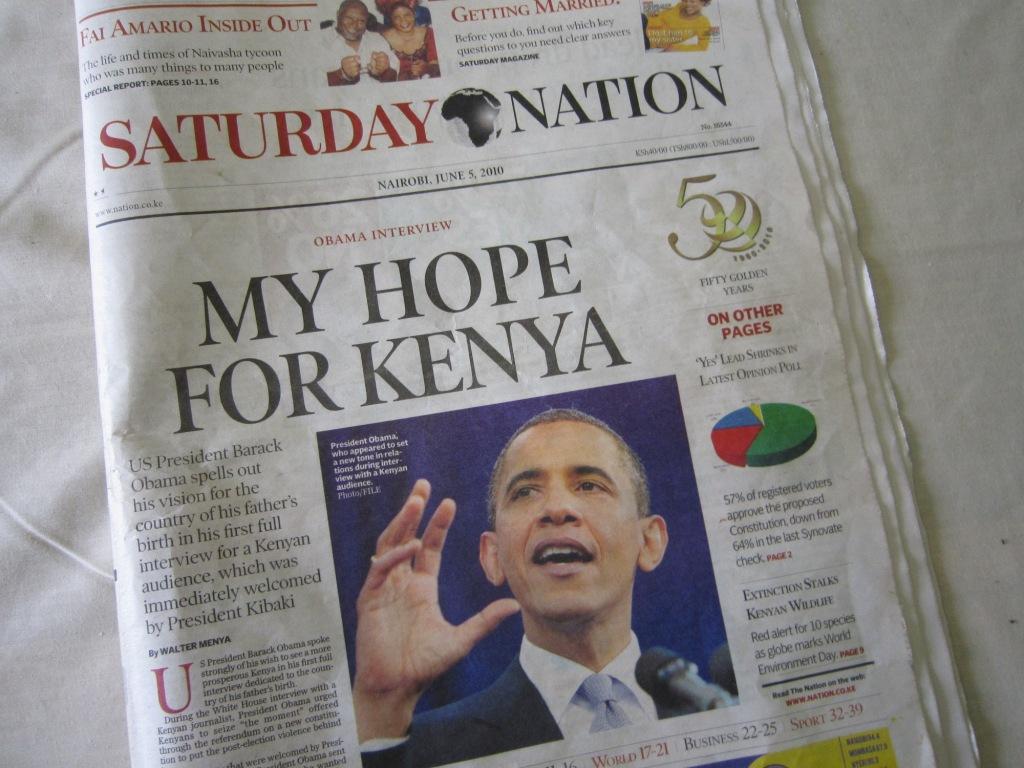
Meanwhile, the major Kenyan newspaper, The Daily Nation, seems to be strongly pushing for the adoption of the new constitution. Over the weekend I picked up a paper, and hardly a surprise, whose face is on the cover? Barack Obama, with the headline “MY HOPE FOR KENYA” in bold above his picture. A Kenyan journalist had interviewed him in the White House last week and the focus was largely on the proposed constitution. Obama encouraged the constitutional referendum process, urging Kenyans to seize this moment as a “singular opportunity to put Kenyan governance on a more solid footing that can move beyond ethnic violence, can move beyond corruption, and can move the country towards a path of economic prosperity.” Although Obama was careful not to actually endorse the proposed constitution, his words seem to imply approval, and I think there is no question that his opinion resonates with Kenyans.

And although Kenyans would love to host President Obama (or even adopt him as their own President), this week, they got the next closest thing, Joe Biden, who stopped through Nairobi en route to the World Cup in South Africa (picture at left from the Daily Nation). Earlier today, I heard Biden’s speech on Okwemba’s car radio, and his powerful message gave me goosebumps. The section of the speech they played on the radio reads as follows (it’s a little long, but stick with it):

“Kenya feels the effects of these problems and should, because of your wealth of human capital, be a part of a global solution -- a strong African voice on the international stage. But that voice has been muted by internal problems -- problems that have held you back from making an even greater contribution.

“Too many of your resources have been lost to corruption, and not a single high-level official has ever been held accountable for these crimes. Too many of your institutions have lost the people’s confidence. And too many times, Kenya has been divided against itself, torn apart by ethnic tensions, manipulated by leaders who place their own interests above the interests of their country. Too many young people have found nothing but dead ends as they seek opportunity and the path to a better future.

“The crisis that gripped Kenya in the wake of the 2007 elections revealed just how dangerous these forces can be. They are dangerous, but they are not immovable. Change is within your grasp. And that change will be realized when government is transparent, accountable, and participatory; when corrupt officials are called to account in a court of law, instead of meeting only the indifferent shrug of impunity; when political power changes hands peacefully, but the will of the voters, and those who did not prevail decide -- and decide that their efforts should be moved to constructive opposition; when Kenyans have confidence that the courts and the police are honest, and are committed solely to the pursuit of justice; when the members of the political leadership represent a range, a wide range, of viewpoints reflecting and responding to the needs of Kenyans everywhere.

“Your coalition government has agreed to a reform agenda that would bring about the fundamental change that Kenyans are seeking. If implemented fully, corrupt officials will be finally held accountable. The judiciary and the police force will place the pursuit of justice above the pursuit of personal gain. Land rights and ownership will be governed by the rule of law, not by the whims of the powerful. Kenyan women and girls -- the most untapped resource of this nation and almost every nation in the world -- will be ever better positioned to contribute to their communities and their country at every level. And a new constitution will put in place a framework to accelerate those reforms, including reducing executive power by building up the checks and balances of your parliament and your judiciary.”

This speech resembles exactly what America’s role has and must continue to be. We have clear values – participatory government, equal opportunity, justice, freedom of association and expression – and we will never stop promoting them throughout the world, because we believe that these should not just be American rights, but universal human rights. Even if we sometimes fail to hold true to these values, even if we get overzealous in forcing them upon cultures that are not willing to adopt them, we will continue to let our light shine outward and be a voice for the values we were founded on 230 years ago.

This is an exciting time to be an American (Guy) in Kenya. And it's an exciting time for Okwemba and his fellow Kenyans as they hope to take control of their future. The weeks leading up to August 4th will be fascinating. I'll keep you updated.