The picture to your right is of Okwemba, a local driver who Patrick and I use to take us around from school to school. He looks pretty young, but he has six children. I was a bit surprised when he told us the oldest one, a daughter, is seventeen years old (at that point, I felt uncomfortable asking him how old he was, but I would imagine he is at least 35).
He continued telling us about his family, and unprompted by us, he told us that two years ago, when his oldest daughter was fifteen, she was kidnapped by a boy three separate times. He said she lost her virginity (based on context clues, I interpreted this as a euphemism for a much more uncomfortable fact – she was raped). He was outraged by this, and he and his wife pressed charges and the boy was sent to jail. Without explanation, a week later, he was let free again. Clearly, the insinuation is that the boy’s family bribed the judge.
Before reading Half the Sky, I might have been somewhat skeptical of this story, or taken it with a grain of salt, but there are literally two or three stories in the book that read almost verbatim to Okwemba’s. Hearing Okwemba's story really made the book feel closer for me. Now just imagine the stories I would be in the midst of if instead of Kenya, I were moved 400 miles west to the Congo, a place the book calls the most dangerous place in the world to be a woman, a place where female flesh is used as a psychological weapon of war to tear apart families and break down their courage.
I’ve known Okwemba since 2007, when I first visited Kenya. He’s a very friendly, happy guy who is also one of the rare people of Muslim faith around these parts of Kenya. But as he told this story, for obvious reasons, a different passion emerged from him. Clearly, this tragedy has been tough for his family to endure, but as he told us about his pain after realizing the judge had been bribed, he quickly began to tie it into a larger frustration with the culture of corruption present throughout Kenya. Infinitely curious about the United States, Okwemba asked us if these types of things happen in our home country, and when we told him that it doesn’t really happen on the level he had illustrated for us (save for some highly publicized misdeeds by public officials that come up every once in a while) you could see a light come alive in his eyes, as his suspicions had been confirmed. “That’s because America actually cares about its citizens,” he said.
This is a phrase I have heard him repeat in some variation several times in just the week and a half that we have been here so far. As we have driven along Emuhaya Division’s poorly paved roads (where driving consists of driving on whatever side of the road has less potholes, until a car approaches from the opposite direction, in which case you move to the left side of the road), he has asked us if such terrible roads exist in America. “Not really. We pay taxes and the government keeps the roads in good condition,” we replied. “Here in Kenya, the politicians just pocket the money for themselves. That would never happen in America!”
The attitude Okwemba displays towards America in not uncommon amongst Kenyans. In fact, Kenyans perceive America
more favorably than any other foreign country. This was true even before the election of November 2008, but of course, Obama’s presidency has only helped that. If John McCain and Sarah Palin think Obama is a celebrity in the U.S., they should come to Kenya. Obama is EVERYWHERE –on t-shirts, posters, calendars, you name it.
Okwemba’s even got a sticker of him on his car:
Ben proudly displays his Obama t-shirt and inauguration hat, Welliminah has Obama on a light switch, and Obama calendars are a common sight in Kenyan homes:
But most of all, Obama and America can be found on people’s minds and hearts and lips. The optimism and faith I have seen and heard expressed in America is incredibly inspiring and makes me awfully proud of my country. I finally understand America’s potential as a “beacon of light” throughout the world. We’re not perfect, but we try to be. We even acknowledge as much in our founding document.

As for Kenya’s corruption, there still may be some hope. On August 4th, the whole country will vote in a referendum on a new proposed constitution. The government seems to be doing a good job of publicizing it and getting awareness out about it. They have widely distributed copies of the proposed constitution, where it sits in families' living rooms, even here in rural Es’saba village at Welliminah’s house (right), where I have perused it periodically. I have not read the current constitution, so it is hard for me to compare, but from what I have read from it, the proposed constitution seems very strong, identifying clear procedures for election disputes, providing a comprehensive Bill of Rights (it’s actually called that in the text, reeking of American influence), and clearly outlining structure and role of government.
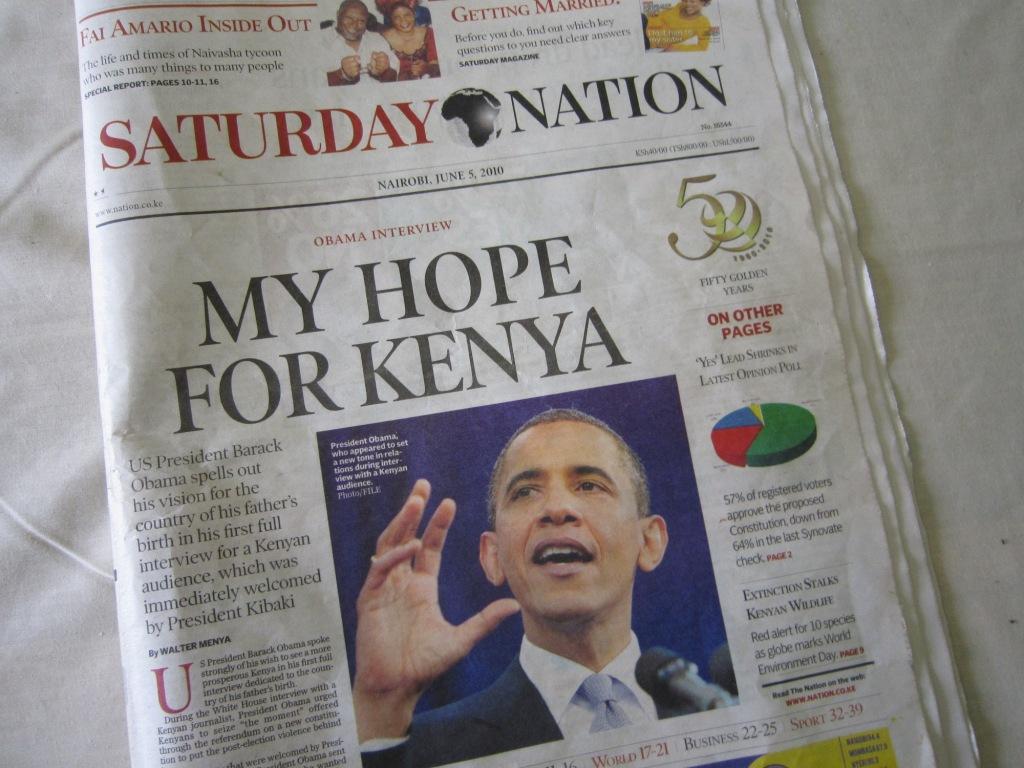
According to a recent poll, 57% of registered voters say they will vote “Yes” for the proposed constitution, 20% will vote “No”, and 19% is still undecided (4% said they won’t vote). This figure, combined with the enthusiasm for the proposed constitution I have seen expressed by people I have interacted with, is encouraging. Okwemba has his doubts though. “The government will find a way to stop this. President Kibaki is against it.” He said that he has heard stories of people being bribed with 5,000Ksh (roughly $60) to vote No. With all that Okwemba has experienced, it’s hard not to share in his skepticism.
Meanwhile, the major Kenyan newspaper,
The Daily Nation, seems to be strongly pushing for the adoption of the new constitution. Over the weekend I picked up a paper, and hardly a surprise, whose face is on the cover? Barack Obama, with the headline “MY HOPE FOR KENYA” in bold above his picture. A Kenyan journalist had interviewed him in the White House last week and the focus was largely on the proposed constitution. Obama encouraged the constitutional referendum process, urging Kenyans to seize this moment as a “singular opportunity to put Kenyan governance on a more solid footing that can move beyond ethnic violence, can move beyond corruption, and can move the country towards a path of economic prosperity.” Although Obama was careful not to actually endorse the proposed constitution, his words seem to imply approval, and I think there is no question that his opinion resonates with Kenyans.

And although Kenyans would love to host President Obama (or even adopt him as their own President), this week, they got the next closest thing, Joe Biden, who stopped through Nairobi en route to the World Cup in South Africa (picture at left from the Daily Nation). Earlier today, I heard Biden’s speech on Okwemba’s car radio, and his powerful message gave me goosebumps. The section of the
speech they played on the radio reads as follows (it’s a little long, but stick with it):
“Kenya feels the effects of these problems and should, because of your wealth of human capital, be a part of a global solution -- a strong African voice on the international stage. But that voice has been muted by internal problems -- problems that have held you back from making an even greater contribution.
“Too many of your resources have been lost to corruption, and not a single high-level official has ever been held accountable for these crimes. Too many of your institutions have lost the people’s confidence. And too many times, Kenya has been divided against itself, torn apart by ethnic tensions, manipulated by leaders who place their own interests above the interests of their country. Too many young people have found nothing but dead ends as they seek opportunity and the path to a better future.
“The crisis that gripped Kenya in the wake of the 2007 elections revealed just how dangerous these forces can be. They are dangerous, but they are not immovable. Change is within your grasp. And that change will be realized when government is transparent, accountable, and participatory; when corrupt officials are called to account in a court of law, instead of meeting only the indifferent shrug of impunity; when political power changes hands peacefully, but the will of the voters, and those who did not prevail decide -- and decide that their efforts should be moved to constructive opposition; when Kenyans have confidence that the courts and the police are honest, and are committed solely to the pursuit of justice; when the members of the political leadership represent a range, a wide range, of viewpoints reflecting and responding to the needs of Kenyans everywhere.
“Your coalition government has agreed to a reform agenda that would bring about the fundamental change that Kenyans are seeking. If implemented fully, corrupt officials will be finally held accountable. The judiciary and the police force will place the pursuit of justice above the pursuit of personal gain. Land rights and ownership will be governed by the rule of law, not by the whims of the powerful. Kenyan women and girls -- the most untapped resource of this nation and almost every nation in the world -- will be ever better positioned to contribute to their communities and their country at every level. And a new constitution will put in place a framework to accelerate those reforms, including reducing executive power by building up the checks and balances of your parliament and your judiciary.”
This speech resembles exactly what America’s role has and must continue to be. We have clear values – participatory government, equal opportunity, justice, freedom of association and expression – and we will never stop promoting them throughout the world, because we believe that these should not just be American rights, but universal human rights. Even if we sometimes fail to hold true to these values, even if we get overzealous in forcing them upon cultures that are not willing to adopt them, we will continue to let our light shine outward and be a voice for the values we were founded on 230 years ago.
This is an exciting time to be an American (Guy) in Kenya. And it's an exciting time for Okwemba and his fellow Kenyans as they hope to take control of their future. The weeks leading up to August 4th will be fascinating. I'll keep you updated.