I returned back to America yesterday afternoon. Patrick and I landed at JFK International Airport in NYC and parted ways. It felt strange being separate, and newly independent for the first time in ten weeks, as he walked away. I couldn't have asked for a better partner-in-service than him this summer. He caught a connecting flight to St. Louis and I am staying in the NYC for a few days to spend time with friends before flying home to Florida. It feels good to be back in the U.S., but I'm already missing Kenya incredibly much.
On the night before we departed, we exchanged gifts with Welliminah and family. After ten weeks of amazingly generous hospitality, Patrick and I were surprised to receive a gift from them as well. We were each given our very own beautiful African kikoi shirt and konga fabric to give to our mothers. They were moving gifts - whenever I wear the shirt I will think of my Kenyan family, their beautiful country, and their warm hearts.
The next morning we were up early to depart. I was proudly wearing my new kikoi shirt. Susan arrived with Okwemba to take us to the airport. In almost perfect symmetry, we ended our stay at Welliminah's house the same as we started - by bowing our heads in prayer. Welliminah said a touching prayer thanking us for our time together and wishing us safe travels until we return to Kenya in the future. I'll never forget what she said: "Our bodies are parting ways, but our spirits remain together." Sitting here in New York, I couldn't agree more, because I can still feel it. On the return flight across the Atlantic, I kept thinking back to our final goodbye in Welliminah's front yard, and I couldn't stop thinking to myself, "Why am I leaving Kenya?". That's how comfortable and natural and alive I felt there. I'm already anticipating the day that our bodies and spirits are reunited once again.
As bittersweet as it was being driven away from Es'saba village in Okwemba's car that morning, there was a large feeling of accomplishment as well. As I took one last look at the beautiful scenery surrounding Kisumu with a clear, sunny, blue sky all around, I knew that we were leaving Kenya better than we found it. And not nearly just because of the success of our projects, although I have great pride in what we accomplished. We were flying away from a new Kenya - a young democracy with a bright future ahead of it, with a new Constitution in tow. The country overwhelmingly passed the new constitution on August 4th, and did so peacefully. As Okwemba, the driver whose interest in politics I profiled in an earlier post, delivered us to the airport, he remarked, "You see, this country now is peaceful and happy because the people have been heard."
Their peace is my own. Their happiness is my own. I will continue to watch Kenya and stay in touch with my family there with much interest in their growth and progress. In the coming months, I will watch as 30 Kenyan students work with 15 American students to promote solutions to the global water crisis. And until the next time I return to Kenya, I will keep their spirit, and my own, alive deep inside my heart.
Myself, Ann, Divo, Welliminah, and Esther the day before I left
Three years ago, I climbed to the summit of Mount Kilimanjaro. But yesterday, I reached a far more rewarding summit. After a nine week climb creating a summit - the Global Student Summit program for Kijana - I reached the top. The picture to the right is what it looked like.
It was a room at Es'saba Secondary School, containing thirty students - ten each from Es'saba, Ebusiloli, and Mwituha Secondary Schools - who have been selected to participate in the program's pilot campaign, "Water Sustainability: Finding Solutions to Fresh Water Scarcity," starting in September and running through May 2011.
The meeting in the picture above was their Student Orientation, where they familiarized themselves with each other and received training to prepare them for the journey they are about to begin. While my nine-week climb to develop the program has just ended, their nine-month climb as participants in the program has just begun. Along with fifteen students from my high school, The Benjamin School in Palm Beach Gardens, Florida, these students will become experts on the global water crisis and work together to promote some serious solutions within their communities, nations, and world. But their summit will reach a much higher peak than mine; they are taking their ideas to the top of the world - to two Presidents, a Prime Minister, two Members of Parliament, two Senators, one Congressman, and to the Secretary General of the United Nations. Together, these 45 students on opposite sides of the world will shine a very bright light on one of the most pressing - and most ignored - problems facing our global village in the 21st century.
During the orientation, each of the students received their own Participant Guide for the Water Sustainability campaign - beautifully printed in full color and spiral-bound - containing readings, reflection questions, and quotations to provoke their imaginations and inspire them to action.
One of those quotations I put in the guide is a favorite of mine from Robert F. Kennedy:
"It is from numberless diverse acts of courage and belief that human history is shaped. Each time a man stands up for an ideal, or acts to improve the lot of others, or strikes out against injustice, he sends forth a tiny ripple of hope, and crossing each other from a million different centers of energy and daring those ripples build a current which can sweep down the mightiest walls of oppression and resistance."
- Robert F. Kennedy
Kijana President and Founder (and my high school teacher) Jim Cummings was also present at the orientation and he made sure to point that quotation out to the students. He asked one of the girls to stand up and read it out loud, and as I listened to her read those words for the first time - with her unique Kenyan pronunciations and occasional reading struggles filling the silent room - I got goosebumps. To hear a young person encounter the words that I have cherished as a sort of Bible verse for public servants was like hearing it again for the first time myself. And somewhere, I know that RFK - the ultimate advocate and believer in the power of young people and the idea of "youth" - was smiling.
Jim and I helped them understand what RFK meant, explaining to them that they are each sending forth their own tiny ripples of hope into the universe. Ripples of hope that would inspire others and one day, after crossing each other from a million different centers of energy and daring, create a powerful tidal wave of hope. Amusingly, Jim even went so far as to point out to the participants that I am a student at the Clinton School of Public Service - a place named after a U.S. President who was born in a place called Hope. I picked up on it and explained that I was inspired by the ripple of hope that President Clinton has sent forth in the world, and now I was passing it on to them, who I hope will then pass it on to others. At this point, the students were beginning to understand the ripple concept, so Jim drove it home by having the students say out loud: "I am a ripple of hope!," louder and louder until they couldn't help but burst out laughing. It was an incredible moment that I will never forget.
And although I used President Clinton in my ripple of hope example, the truth is that Jim is the greatest source of inspiration responsible for any ripples of hope that I have sent forth into the universe. I have known him for ten years now, and I can still remember the first time I met him at Cross Country practice a few days before I started ninth grade. I might not have been able to articulate it, but I knew from that first moment and from the way that he treated me as a young person that there was something different about him that other teachers and adults didn't possess. He has a true gift for teaching and a truly large heart for empowering youth and inspiring them to let their own light shine outward. I was reminded of that again yesterday as I watched him speak to the students at the Orientation, and seeing the smiles that spread across each of their faces. In particular, I have to share the picture above. Jim is pointing to his hat, and while apologizing for wearing it indoors, he explained that he chose to wear it to the Orientation for a good reason. The hat has a simple, but powerfully true message: "There is no Planet B." His point was clear; it's the responsibility of you young people to protect Planet A, our most beautiful, wonderful home, Earth. It's been ten years, and I'm still learning from Jim. And still catching his ripples.
I was extremely pleased with how the Orientation went, and with how my entire project has gone, for that matter. After the session, I had the students go outside for some pictures. Each of them took an individual picture holding their name (see Everlyn's photo to the right), and then as a group. It was incredibly rewarding for me to see the camaraderie that was displayed as the students waited to take their pictures. Students from different schools who hadn't met each other until just two hours before were laughing and smiling and enjoying each others' presence. I'm hoping that a similar level of respect and friendship can be built between the Kenyan and American students when the videoconferences start in September. Although I won't be able to be there myself over the next nine months, I'll be following the students' progress with great interest and pride as they work on their own summit climb together.
More pictures of the good life from the past four weeks in Kenya.
Boga poses with Flat Stanley
Photo shoot with the kids...
Riding my bike at sunset through Es'saba Village's narrow walkways.
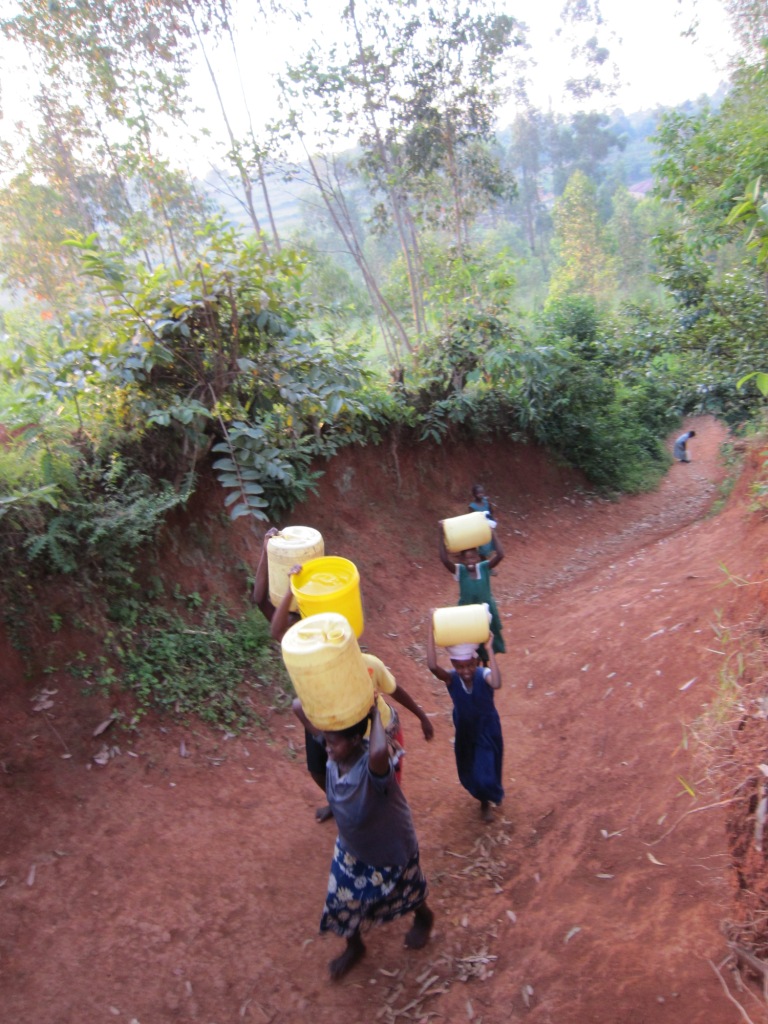
The wet season ended at the end of June, which means that there has been considerably less rain in July. Every night now, there is a line of people waiting to fill up their jerry cans with water from the stream.
These kids are sent out every night before dinner to go fetch some water for their family.
Then they haul the heavy water up the hill. If they're lucky, their family lives close to the spring, otherwise, some have to walk for upwards of a mile.
I fetched some water one night myself, carrying it on my head like these girls. Luckily, Welliminah's house isn't terribly far from the stream. It was a workout though. I had a sore neck afterward. All the villagers laughed at the sight of me carrying water.
A beautiful view at sunset. See that large hill in the distance? We climbed that with Ben. Apparently the local story is that the rain Gods live there (although I don't think anybody around here actually still prays or believes in such Gods).
Boats on Lake Victoria's shore in Kisumu. I was there to arrange a field trip for the students in the program I'm developing. They'll go there in October to learn about the lake, take a tour on these boats, and do community service.
Welliminah told Patrick one night that she wants us to return to the airport in America looking very "healthy" (read: fat), to show our parents how well we were taken care of. She had this hilarious quote: "When you come off the plane looking fat, your parents will be so proud." So Patrick stuffed his pillow under his shirt after dinner one night to show them how fat he's become. Laughter ensued.
Students at Ebusiloli taking down and folding up the flag at the end of the school day.
Vincent receives a bath from Moraa.
A beautiful road on a walk with Ben.
Over the weekend, Patrick and I met our new classmate from Class 6, Shamim Okolloh. Shamim just so happens to be from Kenya - with family roots in the Bunyore area, where we are doing our projects. Although she's lived in Atlanta for several years now, she came back to her high school in Kaimosi to organize the school's very first alumni day. She invited us as well. The school is an all-girls boarding school and is nearly one hundred years old (the oldest alum present graduated in 1936!). Below is a picture of her addressing the over 1200 in attendance. First impressions of Shamim: impressive, confident, awesome.
She also spun a fast one on us and had us address the humongous crowd of students, faculty, and alumni as well, without any preparation. Afterwards, the students bombarded us with questions and picture requests. See below. My favorite question from one of the students: "Do you hate being governed by a black man, Barack Obama?" Apparently she didn't notice I was wearing his t-shirt. My reply: "No, I love it!"
Lastly, I'll leave you with Richie, the subject of the greatest photo I have ever taken (it's now my desktop background):
Inspired by my "Life is Good," water bottle that I drink out of, here are some pictures of the good life from the last four weeks here in Es'saba Village.
Crossing a stream on a walk with Ben
Patrick and Ben crossing the bridge
This was on the first day of the World Cup, June 11th. We went on a walk with Ben just before the first game between South Africa and Mexico, and brought a soccer ball along with us. As we were walking, these kids saw our soccer ball and came out of nowhere, sprinting towards us. So we stopped and played with them for about 30 minutes. They were reluctant to see us finally move on.
A scene of the Kenyan countryside while walking with Ben.
At home with Moraa, little Vincent, Divo, and neighbor Musa.
Divo now knows that "it's great to be a Florida Gator"
And he looks cool with it backwards too. (Also notice the mis-spellings on his shirt)
In the car with Okwemba. Patrick in the front seat.
That jerry can sitting on top of the chair is full of rain water. It's the water Patrick and I use to wash our hands, brush our teeth, and do other things of the sort.
Welliminah's beautiful home at sunset.
A freshly filled can of rainwater.
Neighborhood friends in the back of the house.
Peter (prounounced "Pita"), Divo, Boga.
Big little men at dusk.
Apparently the Terrible Turkey likes to hang out on top of the water tank sometimes. Little Vincent below.
Sitting in the front yard about to begin reading the final chapter of Three Cups of Tea. What an amazing book. So inspiring. One of the best written books I've ever read, as well.
Kitties in the house at the end of the day. Kenyans don't name their cats, so Patrick has named them "Lucky" (on the left, because she looks like his childhood cat, also named Lucky), and "Monkey" (on the right, for the annoying, monkey-like meow she makes). Lucky is Monkey's mother.
Tomorrow will mark the four-week point of my project in Kenya. It's incredible how fast time has moved. But I've made good use of it so far - over the past four weeks, I've been hard at work developing the Global Student Summit program for Kijana. The concept of the program is to engage Kenyan and American youth in cross-cultural interaction and solutions-based dialogue on the world's most pressing issues. Each year, from September-May (following the US academic calendar), participants will collaborate and deliberate a new and different topic that has global relevance.
Kijana's director, Jim Cummings, who is a committed environmentalist, suggested that the focus of the first "campaign" (which is the term I have developed for it in my planning materials) be on global fresh water scarcity, with the goal of promoting solutions for sustainable water management. It is certainly a relevant topic here in Kenya, and whether students in Florida realize it or not, it's important there too.
The past four weeks has involved a lot of learning and research for me. I have become an amateur expert on water issues - or at least as knowledgeable as each of the secondary students who participate in the program should be when they're done with it. And being here in a rural village in Kenya has also given me a first-hand education of the water challenges that are faced in developing regions throughout the world (which Patrick has excellently documented in one of his blog posts).
Aside from the learning and research, my task over the past month has been to figure out how to make this a meaningful program that will broaden students' horizons and understanding of the world, and also make them feel empowered as global citizens and change-makers. Jim's vision for the program was to have a series of videoconferences which would culminate with the students writing and submitting policy proposals for sustainable water management to their national and international leaders - the President and members of Congress in the United States, Kenya's President and relevant Members of Parliament, and the United Nations Environmental Program.
That alone would be a great program, but I knew I could make it even more meaningful. Since I am a student at the Clinton School - a school of Public Service, rather than a school of Public Policy or Public Administration - I know that change cannot be affected through top-down policy decisions alone. The role of change-agent or advocate also calls for creating civic engagement within his or her communities. It means educating and changing hearts, minds, and behaviors. It means getting down on your hands and knees sometimes and getting dirty. It means being on the ground level, communicating with people eye-to-eye rather than staring at a computer screen all day on the 15th floor of a skyscraper. These are the lessons I took away from my first year at the Clinton School, and I am now ready to put them into action.
So in addition to the policy proposals, the students will also get a little dirty themselves. In addition to learning and talking about water, they will experience it, and serve it. In October, I am having the students visit their local bodies of water - Lake Victoria in Kenya and Lake Okeechobee in Florida - in what I am calling a "Local Immersion Mission." They will learn about their local water - its history, the life it supports, the challenges it faces - and then they will contribute to the sustained health of the water, even if it is as simple as picking up trash along the banks. The idea is that there is great importance in actually making that physical connection with water in their region, to help them understand what they are fighting and advocating for.
This idea was inspired by my reading of David Orr's book Earth in Mind, which I think is the most brilliant thing I have ever read. He says, "Water should be a part of every school curriculum....Water as part of our mythology, history, politics, culture, and society, should be woven throughout curriculum, K through PhD...I propose that (water) restoration be made part of the educational agenda. Every public school, college, and university is within easy reach of streams, rivers, and lakes that are in need of restoration. The act of restoration is an opportunity to move education beyond the classroom and laboratory to the outdoors, from theory to application, and from indifference to healing. My proposal is for institutions to adopt streams or entire watersheds and make their full health an educational objective as important as say, capital funds campaigns to build new administration buildings or athletic facilities." While this program won't fully realize Orr's vision, it is a start.
The other major component I have decided to add to the program is to have the students host an education and advocacy event (or series of events) at their schools to mark World Water Day, which is held every year on March 22 (which ironically enough, is also my birthday - perfect considering my last name!). It fits perfectly within the program calendar and will be a great way for the students to put the knowledge they gain to action, by giving them the opportunity to practice their advocacy, leadership, and communication skills within their school communities. It also broadens the impact of the program - I believe their presentations on World Water Day will make a legitimate difference at their schools, and will inspire their peers and even their teachers to make personal commitments to reducing their water consumption. The program will also request that students hold a fundraising drive as part of their World Water Day efforts for Kijana. The idea is for Kijana to take the money raised and pay to have water systems such as gutters and tanks installed at schools in Kenya. And yes, I'm even going to request that the Kenyan students raise money too. Despite the impoverished area they live in, I believe that with enough creativity, they can raise money from their community. This realization will help empower them to believe in their ability to contribute to change. Lastly, I'm going to see if my high school, The Benjamin School will match money raised by their students.
All in all, I want the program to be a holistic learning experience for the students. I've embedded my draft of the Participant Guide (below) that each student will receive and follow along with throughout the program. It's chock full of articles and information about the global water crisis, which will help prepare them for the videoconference discussions and in forming solutions to promote in their policy proposals. But I didn't want the Participant Guide to be an information dump. I wanted to engage them in a broad discussion of the supreme importance and significance of water. David Orr says, "What is the meaning of water? One might as well ask 'What does it mean to be human?' The answer may be found in our relation to water, the mother of human life. When the waters again run clear and their life is restored we might see ourselves reflected whole." Inspired by this, I have aimed to include a broad spectrum of selections in the Participant Guide, readings that will acknowledge the fullness of the students' human spirits and their wide range of interests and abilities. It includes poetry about water, stories about our physical and spiritual connection to water, scientific overviews of our global water resources, and the larger social impact that water scarcity has on the quality of our lives and our development as societies. As I learned in my Education Policy seminar with Don Ernst this past semester (which is where I was exposed to Orr's Earth in Mind), we can be doing a lot better at reaching each of our students on a holistic, human level. This project is my experiment, my effort, to try to do that.
The picture to the right is of students at Ebusiloli Secondary who will participate in the program starting this September.
Below is my draft copy of the Participant Guide. Feel free to browse through it to get a better idea of my project and this program. I would warmly welcome any thoughts or suggestions on the draft. More updates on my project to come.